
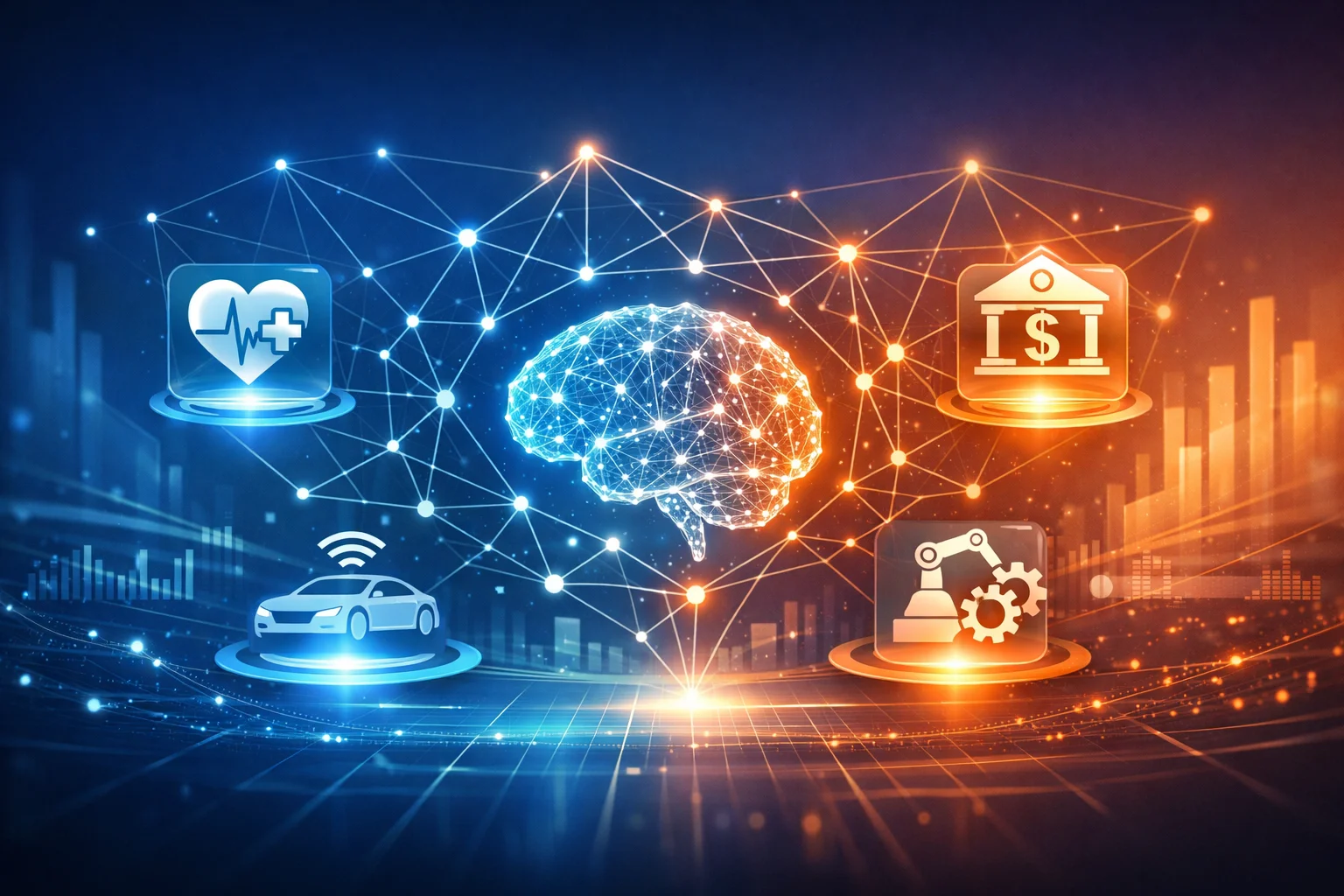
Spectacular advances in artificial intelligence are transforming every aspect of society, from healthcare to finance, mobility, industry and even artistic creation.
Between national ambitions, unprecedented ethical debates and the explosion of concrete applications, France is establishing itself as a key player on the world stage. Human conversation simulations, intelligent fraud detection, or instant medical analyses: behind the magic lie powerful algorithms, mountains of data and a race for strategic innovation.
Between promises of progress and ethical challenges, this comprehensive overview details the history and typology of a field that shapes our collective future. A pedagogical exploration enriched with recent practical cases, French initiatives and essential debates on regulation and trust. From neural network theory to cutting-edge AI laboratories, discover why artificial intelligence is redefining our benchmarks, markets and professions.
📌 Key Takeaways
- Artificial intelligence is defined at the crossroads of mathematics, computer science and philosophy, with a growing impact on society and the economy.
- We distinguish narrow AI (specialized) from general AI (versatile and still hypothetical), with continuous progress on all technical fronts.
- Algorithms, machine learning and deep learning rely on massive data and ever more powerful models.
- Generative AI, now strategic, produces original texts, images and videos, but raises questions of compliance, ethics and quality.
- France is building an ambitious ecosystem between public investments, academic centers, startups and international alliances.
- Regulation, data protection and bias management have become priorities, particularly in healthcare, security or education.
- Models like Devstral or Magistral, and key players such as Meta, Google, IBM or OpenAI, shape the future of AI on a global scale.
Understanding AI: Definitions and Historical Origins
Contemporary Definition of Artificial Intelligence
The term artificial intelligence refers to all techniques aimed at creating systems capable of reproducing certain human cognitive faculties: learning, reasoning, interpreting language, perceiving images or making decisions. Today, AI relies on powerful algorithms that analyze vast volumes of data, extract patterns and adjust their behaviors.
At the crossroads of electricity, computer science and mathematical logic, AI no longer consists only of simulating human thought but also of automating and optimizing complex tasks, sometimes inaccessible to humans. It manifests in assisted medical diagnosis, autonomous driving, natural language processing or computer vision. The contemporary definition emphasizes concrete applications and the ability to generalize learning across varied domains.
Multidisciplinary Concept and Societal Impact of AI
Artificial intelligence is a fundamentally multidisciplinary field. It aggregates cognitive sciences, advanced statistics, neurosciences, philosophy and, of course, computer science. The massive deployment of AI is disrupting existing economic models, revolutionizing healthcare through automated interpretation of medical images, and enriching training paths through personalized educational content.
The innovation driven by AI spreads into public policies, influences legislation and shapes new professions. In 2026, the democratization of assistants based on natural language processing – like ChatGPT – is transforming citizens' daily lives, prompting governments and businesses to anticipate the evolution of necessary skills and adapt continuing education programs.
Founding Contributions: Alan Turing and the 1950s Beginnings
The story of AI truly begins with Alan Turing, the British mathematician whose famous test (the "Turing test") laid the groundwork in 1950 for reflection on a machine's ability to simulate human intelligence. In the 1950s, researchers and engineers designed the first algorithms capable of solving logical problems or playing chess, sketching an autonomous discipline at the frontier between mathematics and philosophy.
From the earliest decades, the ambition was clear: build machines capable of learning by themselves, like humans. Founding conferences, such as Dartmouth in 1956, brought together pioneers of modern computing around the disruptive potential of artificial intelligence.
Main Types and Categories of Artificial Intelligence
Difference Between Narrow AI and General AI
It is fundamental to grasp the distinction between narrow AI, specialized in specific tasks, and general AI, sometimes called "strong," which aims to reproduce the extent of human intelligence. This dichotomy structures the entire field of research and contemporary applications.
Characteristics and Examples of Narrow AI
Narrow AI refers to systems designed to solve a single task: automatic text translation, spam detection, facial recognition, bank fraud prediction, or piloting virtual assistants like Siri, Google Assistant and ChatGPT. These tools rely on highly performant algorithms, optimized for precision in a specific context.
Theoretical Perspective and Challenges of Strong AI Today
Human conversation, complex abstract reasoning, moral judgment, creativity in the broad sense: general AI or strong AI would be capable of mastering and transposing its knowledge across all intellectual domains. However, in 2026, this ambition remains theoretical. Existing systems – even sophisticated ones – do not achieve this cognitive plasticity.

Technical Foundations of Artificial Intelligence
Algorithms, Neural Networks and Machine Learning
The heart of artificial intelligence lies in designing models and algorithms capable of efficiently processing information. Machine learning relies on systems' ability to learn from massive, structured data, adjust their parameters and optimize their performance. These advances rely on artificial neural networks, inspired by biological functioning, which simulate complex learning logic.
| AI Method Type | Principle | Application Example |
|---|---|---|
| Supervised Learning | Model trained on labeled data | Disease detection from X-rays |
| Unsupervised Learning | Automatic discovery of structures in data | Customer segmentation in marketing |
| Reinforcement Learning | Optimization through trials and feedback | Robotics, video games, autonomous navigation |
Deep Learning and Natural Language Processing
Deep learning has revolutionized artificial intelligence since 2012 through stacking neural layers: it excels at exploiting unstructured data like images or text. Progress has been spectacular in voice recognition, automatic translation and virtual avatar creation, exploiting massive volumes of textual or audio data.
The French AI Ecosystem and Its Perspectives
National Strategy and Major Investments in AI
A strategic player on the world artificial intelligence stage, France has been structuring since 2018 an unprecedented framework of actions and investments. The publication of the Villani report marks a decisive step, encouraging stronger research, innovation and expert training.
| French AI Cluster | Specialty | Concrete Result |
|---|---|---|
| Paris Region AI | AI for smart cities | Urban traffic optimization in Paris |
| SophIA Cluster | AI applied to health and medical | Assisted detection of rare diseases |
| MIAI Grenoble | Advanced industrial robotics | Production line automation |
FAQ: Frequently Asked Questions About Artificial Intelligence
What is generative artificial intelligence?
Generative artificial intelligence refers to a category of AI capable of producing original content (text, images, videos) in response to human instructions. It uses powerful models trained on vast data corpora, enabling innovation, automation and personalization.
What are the main risks of AI in healthcare?
Major risks include misinterpretation of automated results, bias in model training, insufficient protection of sensitive data and the risk of losing human medical skills. Regulatory vigilance and regular auditing are essential.
How is France positioned in AI development?
France invests massively in research, training, and infrastructure (AI clusters, Jean Zay supercomputer). It promotes innovation through targeted policies and stands out for its commitment to ethics, regulation and European and international collaboration.
Is it easy to train for AI careers today?
Many courses now exist: university degrees, online certifications, professional training and specialized MBAs. French universities and engineering schools offer courses adapted to all levels, from beginner to expert.
What is the difference between machine learning and deep learning?
Machine learning is a sub-discipline of AI that encompasses all learning techniques from data. Deep learning is a more recent branch, based on multi-layer neural networks, particularly effective on images, sounds and unstructured text.
Stay Informed About AI
Get my best AI tools and tips delivered to your inbox every week.