
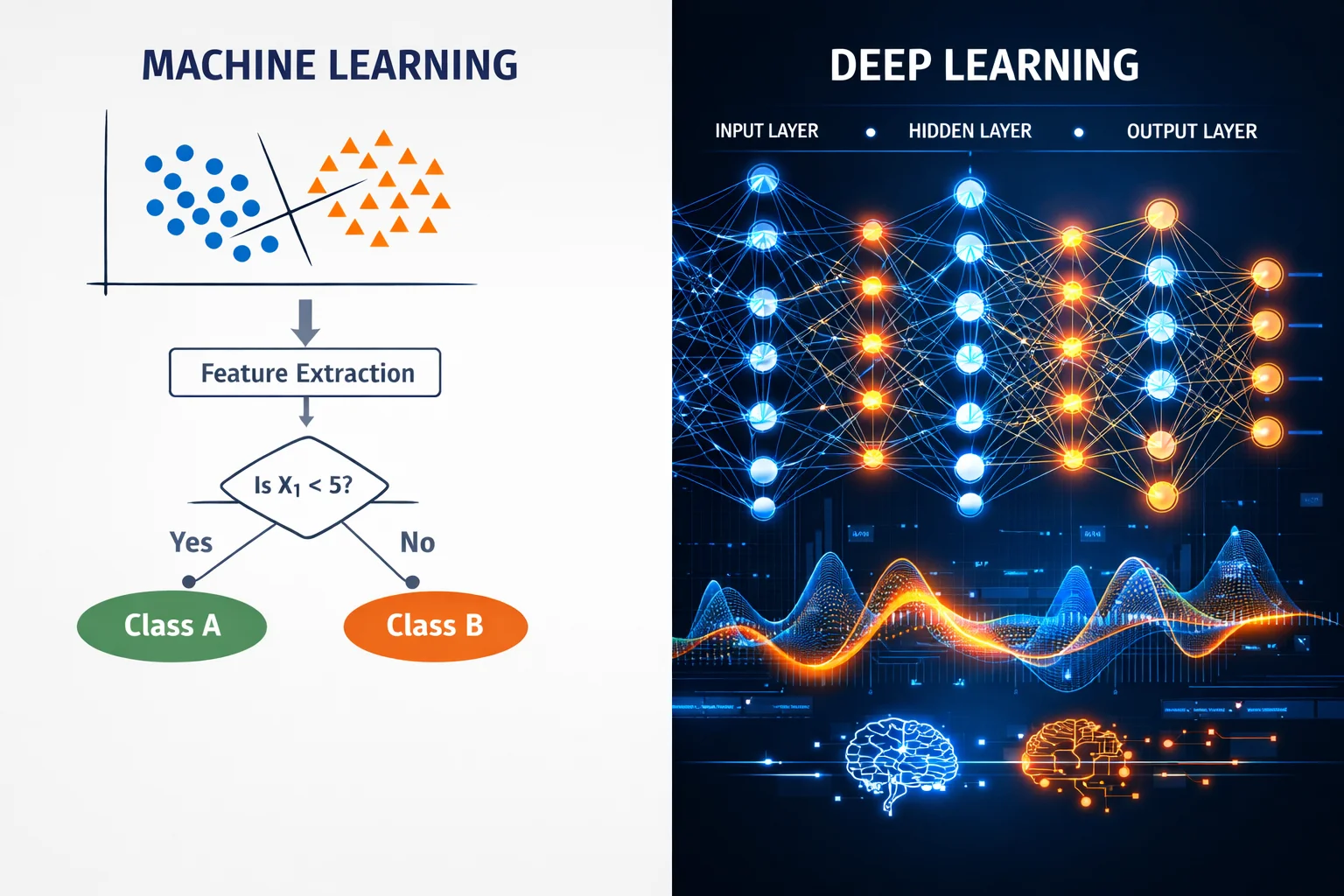
Machine Learning vs Deep Learning: you hear these terms everywhere but you don't really know what the difference between Machine Learning and Deep Learning is? You're not alone. These two approaches are at the heart of modern artificial intelligence, but they don't work the same way.
In this complete comparison guide, I'll explain simply what distinguishes machine learning from deep learning, with concrete examples and a detailed comparison table. By the end, you'll know exactly when to use one or the other.
In this article
- What is artificial intelligence?
- What is Machine Learning?
- What is Deep Learning?
- Machine Learning vs Deep Learning: comparison table
- Key differences explained
- Required data volume
- Training time
- Accuracy and performance
- Required hardware
- Practical Machine Learning applications
- Practical Deep Learning applications
- When to use Machine Learning?
- When to use Deep Learning?
- FAQ - Frequently asked questions
What is artificial intelligence?
Before comparing machine learning and deep learning, we need to understand where they fit in the AI ecosystem.
Artificial intelligence (AI) is the overall field that encompasses all techniques enabling machines to mimic human intelligence. Machine Learning is a branch of it, and Deep Learning is a subcategory of Machine Learning.

For a complete explanation of AI, check out our article Artificial intelligence: definition.
What is Machine Learning?
Machine Learning is a branch of AI that allows algorithms to learn from data to make predictions or classifications without explicit programming.
Concretely, instead of programming specific rules ("if X then Y"), we provide examples to the algorithm which learns to detect patterns itself.
Simple example: spam detection
To create a spam filter using Machine Learning:
- We collect thousands of emails labeled "spam" or "not spam"
- The ML algorithm analyzes these examples and detects patterns (suspicious words, senders, structure)
- Once trained, it can classify new emails it has never seen
Machine Learning characteristics
- Statistical algorithms: decision trees, regression, SVM, k-NN
- Manual feature engineering: humans must identify important features
- Structured data: works well with data tables
- Moderate resources: a standard CPU is often sufficient
What is Deep Learning?
Deep Learning is a subset of Machine Learning that uses multilayer neural networks inspired by the human brain to automatically process complex patterns in raw data.
The key difference: Deep Learning automates feature extraction. It learns hierarchical representations (e.g., first edges, then shapes, then objects in an image).
Simple example: facial recognition
To create a facial recognition system using Deep Learning:
- We provide millions of face images to the neural network
- The model automatically learns to detect features (contours, eyes, nose, mouth)
- It can then recognize faces it has never seen
Deep Learning characteristics
- Deep neural networks: multiple layers of interconnected neurons
- Automatic feature learning: extracts features without human intervention
- Unstructured data: excels with images, text, audio, video
- Significant resources: requires GPU/TPU for massive calculations
Machine Learning vs Deep Learning: comparison table
Here is a summary table of the differences between Machine Learning and Deep Learning:
| Criteria | Machine Learning (ML) | Deep Learning (DL) |
|---|---|---|
| Data volume | Small to medium (thousands of examples) | Very large (millions, Big Data) |
| Training time | Short (seconds to hours) | Long (days to weeks) |
| Accuracy | Good on simple tasks | Superior on complex tasks |
| Hardware | Standard CPU sufficient | GPU/TPU required |
| Feature engineering | Manual (human required) | Automatic |
| Interpretability | Easy to understand | Black box |
| Data type | Structured (tables) | Unstructured (images, text, audio) |
| Cost | Low to moderate | High (GPU infrastructure) |
Key differences explained
Let's dive deeper into each major difference between deep learning vs machine learning:
Required data volume
This is one of the most important differences between ML and DL:
- Machine Learning: Works well with thousands of examples. A spam detection model can be effective with 10,000 labeled emails.
- Deep Learning: Requires millions of examples to reach its full potential. GPT-4 was trained on hundreds of billions of words.
Practical rule: If you have fewer than 10,000 examples, Machine Learning will probably be more effective. Beyond 100,000 examples with complex data, Deep Learning becomes interesting.
Training time
- Machine Learning: Fast training, from a few seconds to a few hours. A decision tree can be trained in seconds.
- Deep Learning: Long training, from several days to several weeks. Training GPT-4 required months of computation on GPU clusters.
Accuracy and performance
- Machine Learning: Good accuracy on simple and structured tasks. Ideal for tabular classification, numerical predictions.
- Deep Learning: Superior accuracy on complex tasks with enough data. Far surpasses ML on vision, natural language, audio.
Required hardware
- Machine Learning: A standard CPU is sufficient for most algorithms. Your laptop can train an ML model.
- Deep Learning: Requires GPUs (graphics cards) or TPUs (specialized processors) for massive matrix calculations. High cost in cloud infrastructure.
Practical Machine Learning applications
Machine Learning is ideal for structured data and tasks where interpretability matters:
- Finance: Credit scoring prediction, fraud detection
- Weather: Short-term weather forecasts
- E-commerce: Recommendation systems (Netflix, Amazon)
- Healthcare: Medical diagnosis on tabular data
- Marketing: Customer segmentation, churn prediction
- Maintenance: Industrial failure prediction
Practical Deep Learning applications
Deep Learning excels on unstructured data and complex tasks:
- Computer vision: Facial recognition, autonomous cars, medical imaging
- Language processing: ChatGPT, Claude, machine translation, chatbots
- Audio: Voice recognition (Siri, Alexa), transcription
- Content generation: Midjourney, DALL-E, Sora (video)
- Cybersecurity: Intrusion detection, malware analysis
- Games: AlphaGo, video game agents
When to use Machine Learning?
Choose Machine Learning if:
- Your data is limited (less than 100,000 examples)
- Your data is structured (tables, CSV, databases)
- Interpretability is crucial (you need to explain decisions)
- You want simple predictions without heavy hardware
- You have a limited budget for infrastructure
- You need results quickly
When to use Deep Learning?
Choose Deep Learning if:
- You have massive volumes of data (millions of examples)
- Your data is unstructured (images, text, audio, video)
- You're working on complex tasks (vision, natural language)
- Maximum accuracy is a priority, despite the costs
- You have access to GPU/TPU (cloud or on-premise)
- Training time is not a constraint
FAQ - Frequently asked questions
Here are the questions that come up most often when people try to decide between machine learning and deep learning, with short, concrete answers.
What is the concrete difference between machine learning and deep learning?
Deep learning is a subcategory of machine learning, not a rival technology. The real difference is feature engineering. In classic machine learning, you are the one who identifies the important features before training a decision tree, a regression, an SVM or a k-NN. In deep learning, the multilayer neural network learns those features on its own, hierarchically: first edges, then shapes, then objects in an image. That automation comes at a price: you need far more data, far more compute time, and you lose interpretability, because a deep network behaves like a black box.
Should you learn machine learning before deep learning?
Yes, in that order. Artificial intelligence is the overall field, machine learning is a branch of it, and deep learning is a subcategory of machine learning: you cannot really understand the second without the first. It is also more practical to start there. A decision tree trains in a few seconds on a standard CPU, so your laptop is enough, and you can see straight away which features drive the prediction. Deep learning, on the other hand, calls for GPUs or TPUs, days or even weeks of training, and much heavier datasets.
How much data do you need to train a deep learning model?
Far more than for machine learning. A classic ML model already works well with a few thousand examples: a spam filter becomes effective with around 10,000 labeled emails. A deep learning model needs millions of examples to reach its full potential, and GPT-4 was trained on hundreds of billions of words. My practical rule: below 10,000 examples, machine learning will probably be more effective. Beyond 100,000 examples with complex data, deep learning becomes interesting. In between, always test the simpler approach first.
Do you need a GPU for machine learning or deep learning?
It depends on the approach. For machine learning, a standard CPU is sufficient for most algorithms: your laptop can train a model with no special hardware. Deep learning is another story. The massive matrix calculations of a deep neural network call for GPUs, meaning graphics cards, or TPUs, meaning specialized processors. This is the heaviest cost line in deep learning, especially if you rent cloud infrastructure. If your budget is limited, that is one more reason to start with machine learning.
Is deep learning always more accurate than machine learning?
No. Deep learning far surpasses machine learning on computer vision, natural language and audio, but only when it has enough data. On simple, structured tasks such as tabular classification or numerical prediction, machine learning gives very good results, faster and for much less money. And raw accuracy is not the only criterion: an ML model stays easy to understand, while a deep network is a black box. If you have to justify a decision, in credit scoring or medical diagnosis for example, that interpretability is often worth more than a few accuracy points.
Will deep learning replace machine learning?
No, and this is a common misconception. Deep learning is not better than machine learning in absolute terms: each approach has its own area of expertise. Machine learning remains the reference on structured data, when volumes are moderate, interpretability matters and the budget is limited, for example in credit scoring, short-term weather forecasts, customer segmentation or industrial failure prediction. Deep learning is essential elsewhere: images, text, audio, video, massive volumes and complex tasks. The right choice depends on your context: available data, objective, budget and time constraints.
How does deep learning relate to generative AI like ChatGPT or Midjourney?
Generative AI is an application of deep learning. ChatGPT, Claude, Midjourney, DALL-E and Sora all rely on deep neural networks trained on colossal amounts of data: GPT-4 was trained on hundreds of billions of words, and its training required months of computation on GPU clusters. This is exactly the kind of task classic machine learning cannot handle: unstructured data, very complex patterns, automatic feature extraction. Using these tools day to day, on the other hand, needs no GPU and no dataset: the whole cost sits with whoever trains the model.
Conclusion
The difference between Machine Learning and Deep Learning essentially comes down to data volume, task complexity and available resources:
- Machine Learning: Ideal for structured data, moderate volumes, need for interpretability and limited budget
- Deep Learning: Essential for unstructured data (images, text, audio), massive volumes and complex tasks
Deep Learning is not "better" than Machine Learning - each approach has its area of expertise. The right choice depends on your context: available data, objective, budget and time constraints.
To get started with these technologies, check out our guide How to use AI which shows you how to leverage ChatGPT, Claude and other tools in your daily life.
🚀 Stay ahead on AI
Get the latest AI news, tools and tips delivered to your inbox every week.