
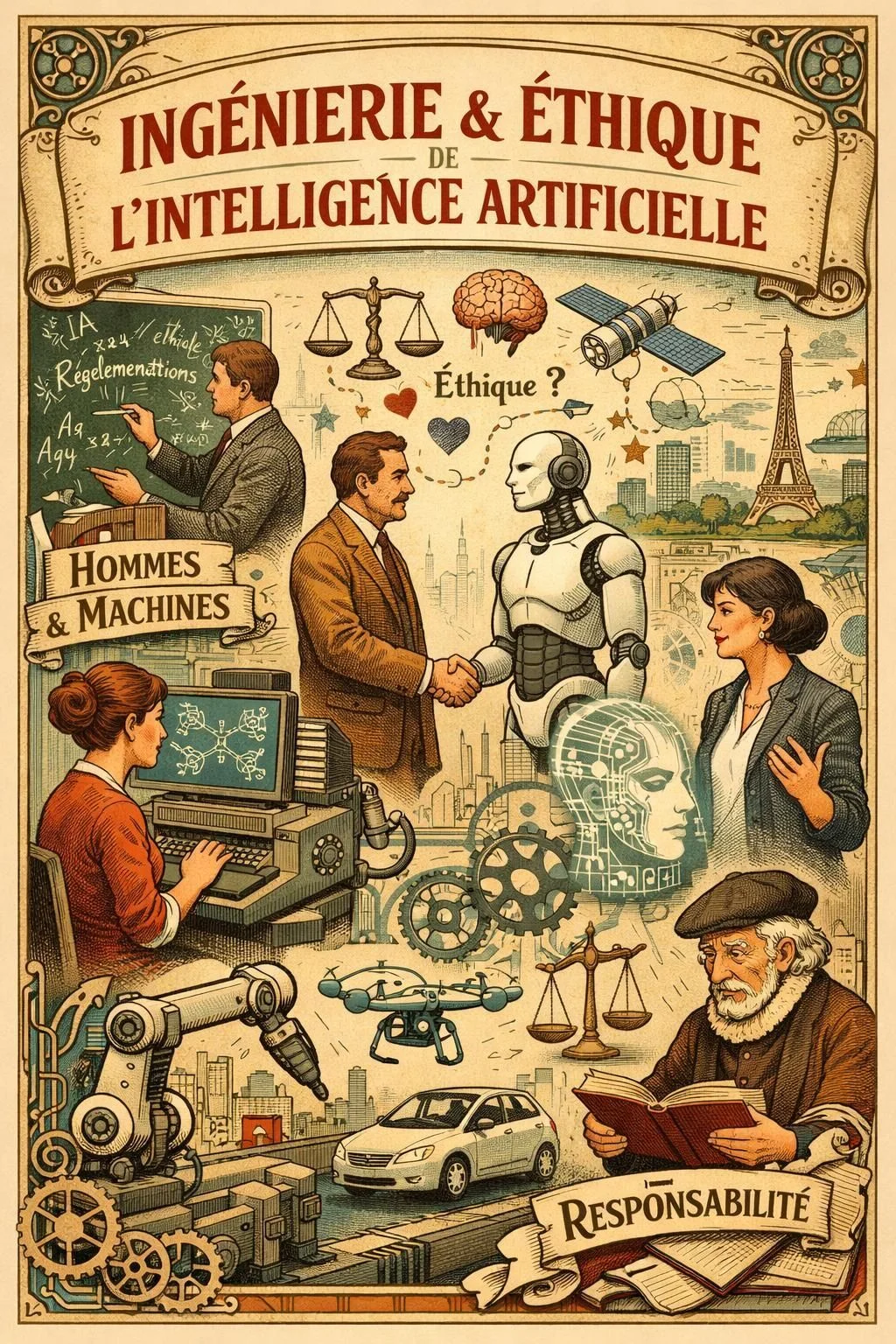
The landscape of artificial intelligence is both rich and evolving today. This text offers a structured exploration from the historical origins of AI to the geopolitical, technological and societal challenges shaping its future.
At the heart of this analysis is a simple and powerful idea: AI aims to simulate intelligent behaviors through computer systems. This definition, largely based on concepts established by the European Parliament, may seem abstract but manifests concretely in various fields from education to healthcare, through industry and research.
Key Takeaways
- A precise definition of artificial intelligence and its historical origin.
- A presentation of the main types of AI (weak, strong, general) and current technological horizons.
- An overview of concrete AI uses in education, healthcare, transportation and research.
- An insight into the French strategy and national ecosystem.
- Analyses on risks and ethical challenges, with particular attention to regulation.
Definition and Historical Origins of Artificial Intelligence
The concept of artificial intelligence is rooted in human curiosity about objects that think or learn. In the 1950s, the formulation of bold ideas about machines capable of simulating reasoning opened a new path for research and technological ingenuity.
Among the figures who marked this turning point, the memory and influence of Alan Turing remain fundamental. His work on the limits of reasoning and imitation tests served as a conceptual compass for evaluating a machine's ability to "think" like a human.
Typologies and Key Technologies of Artificial Intelligence
Differences Between Weak, Strong and General AI
Weak AI is designed for specific tasks, operating often without awareness or global understanding. This form of AI is today the most widespread and mature.
Strong AI refers to an architecture capable of autonomous reasoning in various domains and potentially achieving higher levels of general intelligence in certain situations.
General AI aims to reproduce a wide range of human cognitive abilities and transfer them to non-biological systems.
Societal, Economic and Technological Impacts
In healthcare, AI transforms diagnosis, treatment tolerance and hospital service management. The transportation sector benefits from AI advances, with autonomous vehicles and traffic management systems that optimize flows and reduce emissions.
Geopolitical Challenges and Future Perspectives
The military use of AI raises sensitive ethical and strategic questions. In the United States, research and entrepreneurial ecosystem remain major drivers. In China, national strategy emphasizes rapid emergence of industrial and technological capabilities. Europe seeks to combine digital sovereignty with cooperation.
Stay Informed About AI
Get my best AI tools and tips delivered to your inbox every week.