
TL;DR
OpenAI begins testing ads in ChatGPT starting January 2026, initially in the US on the free version and ChatGPT Go ($8/month). Plus, Pro, Business and Enterprise subscribers remain ad-free. Ads will appear at the bottom of responses, clearly labeled and without influencing content. OpenAI promises never to sell your data to advertisers and gives you full control over ad personalization.
Table of Contents
In this article
Official Announcement: When, Where, How?
OpenAI has officially announced the launch of a test phase for ads in ChatGPT. This announcement is part of a busy January 2026 for AI news. Here are the key details:
Timeline and rollout
- Launch: Test phase "in the coming weeks" (January-February 2026)
- Geography: US only for this first phase
- Target: Adult users (18+) only
- Versions affected: Free ChatGPT and ChatGPT Go ($8/month)
Where will ads appear?
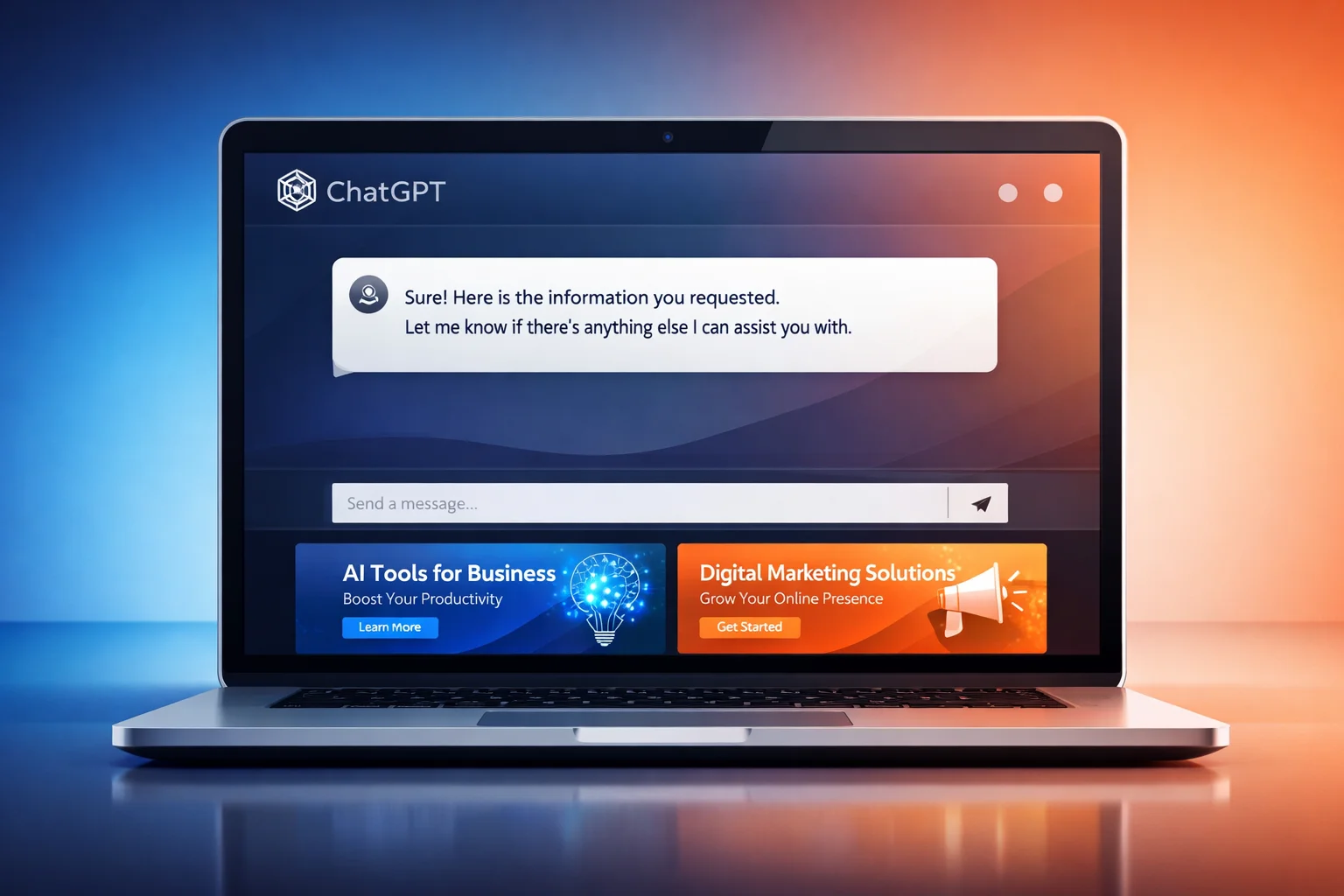
Ads will display at the bottom of ChatGPT responses, when a sponsored product or service is deemed relevant to your current conversation. For example, if you ask "which project management tool should I choose?", an ad for a productivity software could appear below the response.
Clear identification
OpenAI commits to sponsored content being:
- Clearly identified as advertisements
- Visually separated from the main response
- Accompanied by explanations of why this ad is shown to you
Who's Affected? (Free vs Paid)
Here's a summary table of different ChatGPT versions and their ad status:
| ChatGPT Version | Monthly Price | Ads | Details |
|---|---|---|---|
| ChatGPT Free | Free | Yes | Test target |
| ChatGPT Go | $8 | Yes | New intermediate offering |
| ChatGPT Plus | $20 | No | Remains ad-free |
| ChatGPT Pro | $200 | No | Remains ad-free |
| ChatGPT Business | From $30/month | No | Remains ad-free |
| ChatGPT Enterprise | Custom pricing | No | Remains ad-free |
What this means for you
- If you use ChatGPT for free: You'll see ads, but you can control them (see "User protections" section)
- If you have ChatGPT Go: You get a cheaper paid version, but with ads
- If you have ChatGPT Plus or higher: You remain protected from ads, it's a benefit of your subscription
How Do the Ads Work?
OpenAI's advertising model
Unlike traditional search engines (Google, Bing), ads in ChatGPT are not keyword-based, but based on conversational context. The AI analyzes your conversation in real-time to suggest relevant ads.
Concrete example:
- You ask: "I'm looking for a tool to create AI videos"
- ChatGPT responds with a list of tools
- At the bottom of the response: an ad for a sponsored video creation software

Format and interaction
OpenAI describes ads as an opportunity to go beyond traditional formats. You'll be able to:
- Ask questions directly about the ad to learn more
- Interact with the advertised product/service without leaving ChatGPT
- Make purchase decisions based on your specific needs
It's a different approach from static banners: ads become conversational.
Frequency and density
OpenAI hasn't specified the exact frequency of ads (how many per conversation, per day, etc.). This information should emerge during the test phase.
User Protections and Privacy
OpenAI strongly emphasizes three points. This focus on security aligns with their broader approach to securing AI web agents:
1. Your data is never sold
- Conversations and user data are never used for advertising purposes with advertisers
- OpenAI never sells your data to advertisers
- Advertisers don't see your conversations
2. Ads never influence responses
- ChatGPT will answer your question independently
- Displaying an ad doesn't change the quality or honesty of the response
- No "advertising bias" in recommendations
3. You have control
- You can disable ad personalization in settings
- You can delete data used for advertising purposes at any time
- You can hide an ad by giving a reason (not relevant, offensive, etc.)
- You can understand why an ad is shown to you via a "Why this ad?" button
Exclusions and safeguards
OpenAI has defined exclusions for ads:
- No ads for minors: Accounts declared as minors (or detected as such) will see no ads
- No sensitive ads: No ads "near" regulated or sensitive topics:
- Health and mental health
- Politics and elections
- Finance and sensitive investments
- Other regulated areas
SEO Impact and Marketing Implications
Why this is a turning point for marketing and SEO
This announcement marks a major change in the user journey and customer acquisition. For those looking to adapt, exploring the best free AI tools of 2026 can help diversify your marketing stack. Here's why this matters:
1. Arbitrage between organic links and ads
Until now, ChatGPT users received responses without an advertising layer. With the introduction of ads, the user journey changes:
- Before: ChatGPT response - User clicks on an organic link (or not)
- After: ChatGPT response - Sponsored ad - User clicks on the ad or an organic link
Advertisers could convert users more easily who are looking for recommendations or comparisons, as the ad appears at the moment of need, in the conversation context.
2. New opportunities for brands
Products and services that are "naturally relevant" in a conversation become the best ad placements:
- Comparisons: "Which project management tool should I choose?" - Ad for Asana, Monday.com, etc.
- Recommendations: "Which AI design software do you recommend?" - Ad for Canva, Adobe Firefly, etc.
- Buying guides: "How do I choose a VPN?" - Ad for NordVPN, ExpressVPN, etc.
Implication: Brands must adapt to this new advertising channel and understand how to be relevant in an AI conversation, not just on keywords.
3. Impact on traditional SEO
With ads in ChatGPT, organic traffic to websites could slightly decrease for certain queries:
- Users who find an answer plus a relevant ad in ChatGPT will have less reason to click on a Google link
- Comparison sites, buying guides and recommendations could be most impacted
- However: Sites with unique content, detailed reviews or specific use cases will remain attractive
SEO Implication
You need to diversify your acquisition (not just Google) and create content that ChatGPT cannot replace (personal experiences, detailed reviews, proprietary data).
4. Ad measurement and quality
OpenAI has planned a user feedback system ("Why this ad?" button, hiding with reason). This creates an unprecedented quality signal:
- Poorly targeted ads will be hidden quickly
- OpenAI can measure ad relevance better than traditional advertising platforms
- Advertisers must be highly relevant or risk being hidden
Marketing implication: Quality and relevance become critical. Generic or poorly targeted ads will be punished by users.
Strategy for creators and marketers
If you're a content creator or marketer:
- Follow the test: Observe what types of products/services are advertised and how
- Prepare: If your product is relevant for ChatGPT, consider an OpenAI advertising strategy
- Strengthen your SEO: Create content that ChatGPT cannot replace (reviews, use cases, proprietary data)
- Diversify: Don't rely solely on Google for your traffic
Europe Context: When for Us?
Timeline for Europe
OpenAI has not confirmed a date for launching ads in Europe. Here's what we know:
- Phase 1 (January-February 2026): US only, adult users
- Phase 2 (probable, date unknown): Expansion to English-speaking countries (UK, Canada, Australia, etc.)
- Phase 3 (date unknown): Expansion to Europe, subject to regulatory adaptation
Regulatory challenges in Europe
Europe has stricter rules than the US regarding advertising and data protection. As we discussed in our article on AI regulation in Europe and its impact on innovation, OpenAI will need to adapt its model for:
- GDPR: Respect consent and personal data protection rules
- ePrivacy Directive: Manage cookies and ad tracking
- Transparency rules: Be clear about how ads are targeted
- Sensitive content regulation: Adapt ad exclusions according to local laws
Prediction: Ads will likely arrive in Europe 6 to 12 months after the US test, once OpenAI has adjusted its model.
What this means for you (in Europe)
- Currently: No ads in ChatGPT in Europe
- Short term: No change expected
- Medium term (late 2026): Be ready to see ads in ChatGPT if you use the free or Go version
Open Questions and Unclear Points
What OpenAI hasn't specified
Despite the announcements, several gray areas remain:
1. What non-conversational signals are used?
OpenAI says conversations are never used for advertising purposes. But what about other signals like:
- Your location (country, city)
- Your language
- Your device (mobile, desktop)
- Your search history (outside ChatGPT)
- Your demographic profile (age, gender, etc.)
OpenAI's response: No details provided. Monitor during the test.
2. What will be the exact density of ads?
- How many ads per conversation?
- How many per day?
- Will they accumulate in long conversations?
OpenAI's response: To be determined during testing.
3. How will advertisers be selected?
- Will OpenAI accept all advertisers?
- Will there be ad moderation?
- How can advertisers sign up?
OpenAI's response: No details provided.
4. What will be the pricing model for advertisers?
- Cost per click (CPC)?
- Cost per impression (CPM)?
- Cost per conversion?
- Automatic bidding like Google Ads?
OpenAI's response: No details provided.
5. Will ads be present in the ChatGPT API?
Will developers using the ChatGPT API also see ads? Probably not, but not confirmed.
Conclusion: What It Changes for You
Summary of impacts
For free users
- You keep access to ChatGPT for free
- You'll see ads (but you can control them)
- Your data won't be sold
- Ads don't influence responses
For marketers
- New contextual advertising opportunity
- Potential impact on traditional SEO traffic
- Need to create unique content
- Diversification of acquisition channels
Key takeaways
OpenAI is testing a new form of monetization: contextual and conversational ads. It's a turning point for digital marketing, as it creates a new acquisition channel at the moment of user need.
However, OpenAI emphasizes user protection: no data selling, user control, transparency, and exclusions for sensitive topics.
To monitor: Results of the US test, geographic expansion, and the real impact on SEO and marketing.
FAQ: Frequently Asked Questions About Ads in ChatGPT
Will my data be sold to advertisers?
No. OpenAI states that conversations and user data are never sold to advertisers. You maintain control and can disable personalization at any time.
Will ads influence ChatGPT's responses?
No. OpenAI commits to responses remaining independent and honest, regardless of displayed ads.
When will ads arrive in Europe?
No date confirmed. Testing begins in the US in January 2026. European arrival depends on results and regulatory adaptation (GDPR, etc.).
Can I disable ads?
Yes, partially. You can disable ad personalization and hide individual ads. However, if you use the free or Go version, you cannot completely eliminate ads. For that, upgrade to ChatGPT Plus or higher.
What is ChatGPT Go's price?
$8 per month. It's a new intermediate offering between the free version (with ads) and ChatGPT Plus ($20/month, ad-free).
How does OpenAI choose which ads to display?
By analyzing your conversation context. If you ask about a product or service, a relevant ad may appear at the bottom of the response.
Will minors see ads?
No. OpenAI excludes accounts declared as minors (or detected as such) from ads.
What impact will this have on SEO?
Potentially, comparison and buying guide sites could see decreased organic traffic, as users find answers plus relevant ads directly in ChatGPT. However, sites with unique content will remain attractive.
Useful Resources
Do you use ChatGPT for free? Are you ready to see ads, or will you upgrade to a paid version?
🚀 Stay ahead on AI
Get the latest AI news, tools and tips delivered to your inbox every week.