
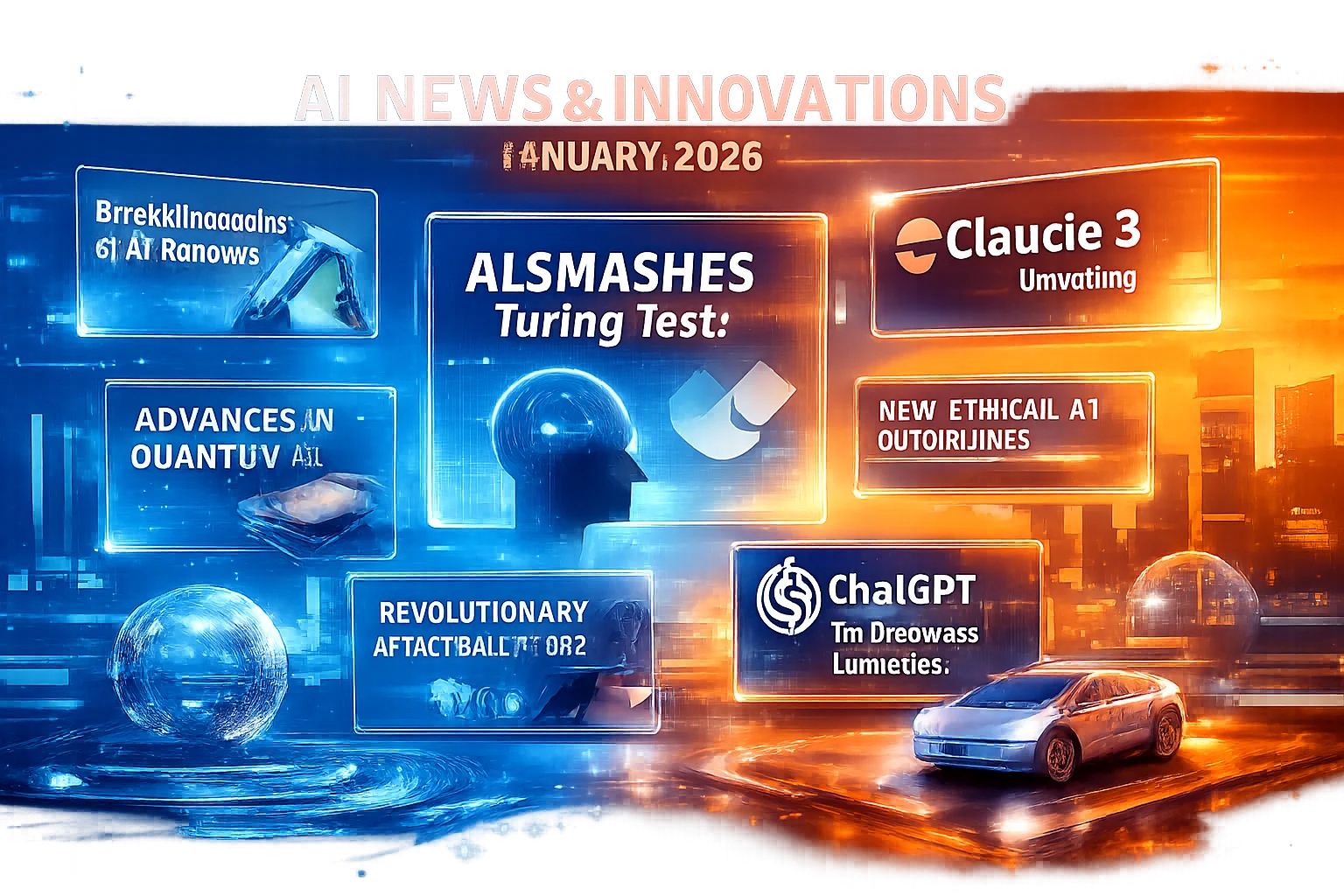
TL;DR: In January 2026, AI continues its revolution with major updates from Claude and ChatGPT, the emergence of new specialized tools, and an acceleration of generative AI accessibility. The three key trends: more powerful multimodal models, increased accessibility, and AI integration into professional workflows.
In this article
Hot AI News for January 2026
Claude AI: Major Evolutions and Expansion
Claude continues to dominate the AI assistant market with increasingly impressive capabilities. In January 2026, Anthropic announced significant improvements:
- Better context understanding: Claude can now process longer and more complex documents
- Extended language support: Language optimization becomes a priority, with specific tweaks for linguistic nuances
- Simplified API integration: Developers can integrate Claude more easily into their applications
- Reduced costs: Pricing drops for small businesses and creators
Why does this matter? Claude AI is becoming accessible to SMBs and independent creators, democratizing access to high-level AI.
ChatGPT: New Features and Increased Competition
OpenAI isn't staying idle. The latest ChatGPT updates include:
| Feature | Description | Impact |
|---|---|---|
| Advanced Reasoning Mode | Real-time complex problem solving | Better for analytical tasks |
| Improved Image Generation | Superior and faster visual quality | Content creators benefit |
| Native Integrations | Connection with Microsoft 365 | Increased productivity |
| Enhanced Multilingual | Improved support for 50+ languages | Global accessibility |
The context: Competition between Claude and ChatGPT is intensifying, driving innovation at a frantic pace. Meanwhile, OpenAI is testing ads in ChatGPT to diversify its revenue streams.
Emerging AI Tools to Watch in 2026
Beyond the giants, new players are transforming the landscape:
Content Creation Tools
- Synthesia 2.0: Video generation with ultra-realistic AI avatars
- Runway Gen-3: Fully AI-powered video editing
- Jasper AI: Marketing content writing with native language support
Professional Tools
- Notion AI: Direct AI integration in databases
- Figma AI: AI-assisted interface design
- GitHub Copilot X: Collaborative programming with AI
Specialized Tools
- Descript: Intelligent audio/video transcription and editing
- Midjourney v7: Even more realistic image generation

The State of Generative AI in January 2026
Massive Enterprise Adoption
The numbers speak for themselves:
- 88% of organizations report regularly using AI in at least one business function, up from 78% a year earlier, according to McKinsey's State of AI survey published in November 2025
- Adoption still sits largely at the pilot stage: most companies cannot yet point to a measurable effect on the bottom line
- Functions leading adoption: marketing and sales, customer service, software development
Key Trends
1. Increased Personalization
AI models are becoming more adaptable to the specific needs of each company and sector.
2. Security and Compliance
With the rise of AI, personal data and GDPR compliance questions become critical.
3. Ethical AI
Companies are investing in responsible and transparent AI solutions.
4. Open-source Models
Free and open-source alternatives (Llama 4, Mistral) are gaining popularity.
How to Take Advantage of AI News in January 2026
For Content Creators
- Use Claude AI to generate ideas and drafts
- Explore Midjourney v7 or Synthesia to create visual content
- Automate transcription with Descript
For Developers
- Integrate Claude API into your applications
- Use GitHub Copilot X to accelerate development
- Test open-source models like Llama 4
For Entrepreneurs
- Adopt an AI solution for your customer service (chatbots)
- Automate repetitive tasks with Zapier + AI
- Explore AI marketing tools like Jasper
FAQ: Your Questions About AI News
Q1: What is the best AI in January 2026: Claude or ChatGPT?
A: It depends on your use case. Claude AI is better for long document analysis, nuanced writing, and language nuances. ChatGPT is better for versatility, images, and integration with other tools. Tip: Test both free versions to see which suits you best.
Q2: Do I need to pay to access these AI tools?
A: Not necessarily. Claude offers a free version (with limitations). ChatGPT offers a free version + ChatGPT Plus (paid). Open-source alternatives like Llama and Mistral are free. Estimated budget: $20-50/month for light professional use.
Q3: What are the risks of generative AI in 2026?
A: Main risks include: AI hallucinations (AI can make up information), algorithmic bias (reproduction of biases in training data), security (data leak risks), employment (automation of certain jobs). Tip: Use AI as an assistance tool, not a complete replacement.
Q4: How can I stay updated on AI news?
A: Several reliable resources: Specialized newsletters (Andrew Ng's The Batch, Import AI), Blogs (EverydayAITech, Hugging Face Blog), Social media (follow AI researchers and companies on LinkedIn/X), Conferences (NeurIPS, ICML, AI Summit).
Useful Resources
Mentioned AI Tools
- Claude AI: claude.ai - General AI assistant
- ChatGPT: openai.com - Main Claude competitor
- Midjourney: midjourney.com - AI image generation
- GitHub Copilot: github.com/features/copilot - AI-assisted programming
- Jasper AI: jasper.ai - AI marketing writing
- Descript: descript.com - AI audio/video editing
Official Resources
- Anthropic (Claude): anthropic.com - Official blog and documentation
- OpenAI (ChatGPT): openai.com/blog - Official news
- Hugging Face: huggingface.co - Open-source AI hub
- AI Index Report: aiindex.stanford.edu - Annual AI state report
Conclusion
January 2026 marks a turning point in generative AI adoption. With Claude AI becoming more accessible, ChatGPT constantly innovating, and a multitude of specialized tools emerging, opportunities are immense.
AI is no longer futuristic technology - it's a practical and accessible tool for creators, developers, and entrepreneurs. The question is no longer "should I adopt AI?" but rather "how do I effectively integrate it into my workflow?"
Ready to explore? Start by testing Claude AI or ChatGPT for free, and discover how these tools can transform your productivity.
Have questions about AI news? Subscribe to our newsletter to stay updated!
🚀 Stay ahead on AI
Get the latest AI news, tools and tips delivered to your inbox every week.