
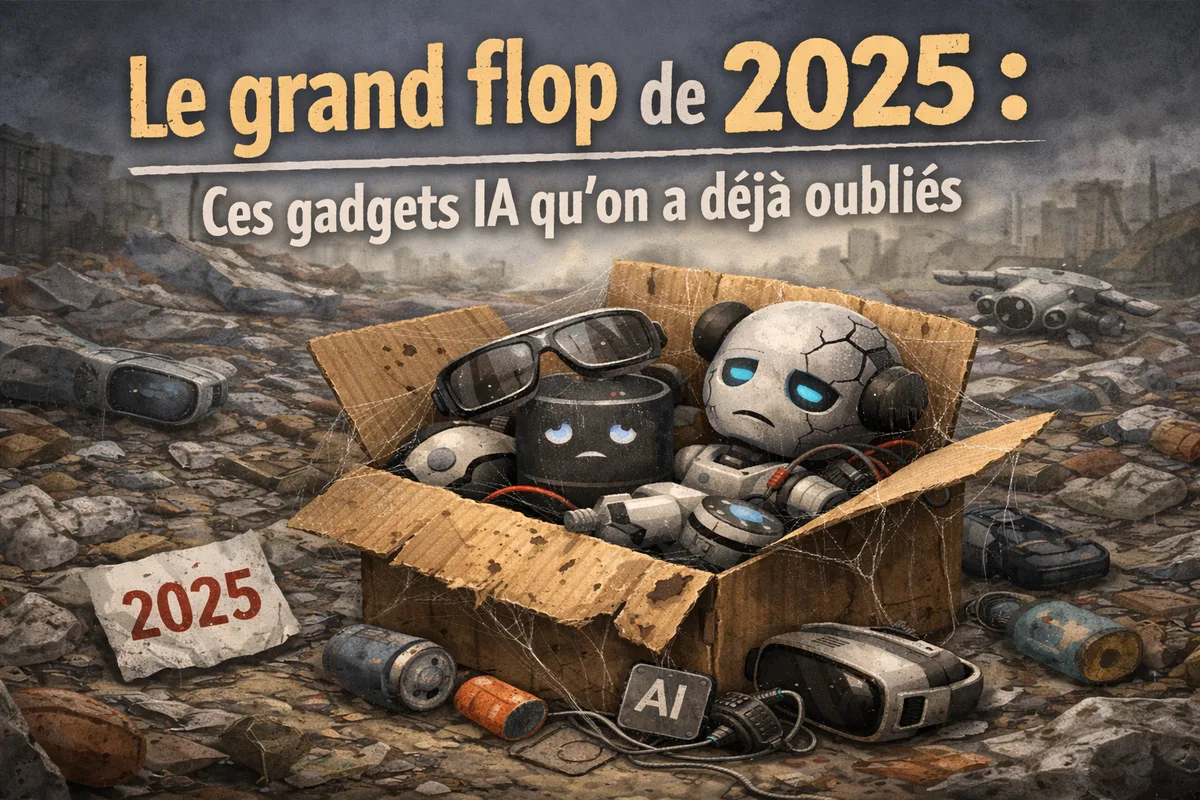
Remember the excitement from early 2024? Tech media was buzzing about a new generation of gadgets that would "replace your smartphone" and "revolutionize your daily life with AI."
I was tempted to pull out my credit card myself. The idea of a small device worn on my jacket lapel that would read my messages and answer my questions without me having to touch my phone? It felt like science fiction becoming reality.
Spoiler alert: we got played. Or at least, the early adopters who dropped up to $699 on these gadgets did.
In this article, I'll give you an unfiltered review of the AI gadgets that flopped spectacularly in 2025. You'll discover why they failed, what it teaches us about the industry, and most importantly, how to avoid falling for the next "revolutionary gadget."
What We Were Promised (And Why We Believed It)
In late 2023 and early 2024, the tech world was buzzing. ChatGPT had opened the floodgates, and everyone wanted their slice of the AI pie. Two startups in particular caught everyone's attention—and all the investors.
Humane was founded by former Apple executives. Their AI Pin promised a "post-smartphone" future with a laser projector that displayed information directly onto your palm. Price: $699 + $24/month subscription.
Rabbit made waves at CES 2024 with its R1, a flashy little orange box for $199. Its "Large Action Model" was supposed to order an Uber, book a restaurant, or manage your apps on your behalf.
What we should have seen coming: these devices promised to do what our smartphones already do... but worse. That's what I call "the unnecessary gadget syndrome."
The Top 4 AI Gadgets That Failed in 2025
1. Humane AI Pin – The Most Spectacular Failure
It's officially over. In February 2025, HP acquired what was left of Humane for $116 million—a fraction of the $200 million raised. And the worst part? The AI Pin was "bricked": no user can use it since February 28, 2025.
Why it crashed:
- Constant overheating – the laser projector ran so hot that Humane had to recall the batteries
- Slow responses – sometimes 10 seconds for a simple query
- No screen – impossible to read anything in direct sunlight
- Prohibitive price – $699 + subscription for a gadget less useful than a free app
My expert take: Humane confused "innovation" with "different." Removing the screen wasn't an improvement—it was a handicap.
2. Rabbit R1 – The Gadget That Didn't Know What to Do
The Rabbit R1 sold 100,000 units in pre-orders. Impressive, right? Except that 5 months after launch, only 5,000 active users remained. That's a 95% abandonment rate.
The major issues:
- The famous "Large Action Model" only worked with a handful of applications
- Security flaws exposed user data through the APIs
- Couldn't make calls or send texts (yes, really)
Founder Jesse Lyu himself admitted the device was launched too early. At least he's honest.
3. Friend AI Pendant – The Friend Who Forgets Your Name
This one deserves a special mention for the most dystopian concept of the year. Friend is a $129 pendant that listens to you constantly and sends you "friendly" texts.
What went wrong:
- A 7 to 10 second delay between speaking and the response
- The device regularly forgets the user's first name
- Frequent disconnections mid-conversation
- A $1 million ad campaign in the New York subway... vandalized by commuters with "AI is not your friend"
Shocking stat: Only 3,000 units sold for 1,000 shipped. The founder himself admits he "doesn't have much money left."
4. The Other Contenders for Flop of the Year
Let's not forget their companions:
- Limitless Pendant – a "smart" audio recorder that transcribes your conversations. Problem: nobody wants to wear a spy device around their neck.
- Plaud NotePin – same concept, same problems. The market simply doesn't exist.
- Apple Vision Pro – not really a "flop" in terms of technology, but at $3,499, sales stayed well below expectations.
Comparison Table: The Failures in Numbers
Here's a summary of the main characteristics and reasons for failure of each gadget:
| Gadget | Price | Promise | Reason for Failure |
|---|---|---|---|
| Humane AI Pin | $699 + $24/mo | Replace the smartphone | Overheating, slowness, price |
| Rabbit R1 | $199 | AI agent for your apps | Missing features |
| Friend Pendant | $129 | Permanent AI companion | Latency, forgetfulness, unclear concept |
| Ray-Ban Meta (success) | $379 | Glasses + discrete AI | Improved everyday object |
The difference is stark: the Ray-Ban Meta works because they improve an object people already wear. They don't ask users to change their habits.
4 Lessons to Never Get Fooled Again
Lesson #1: Beware of "Post-Smartphone" Claims
When a startup tells you they're going to "replace your smartphone," run. Your phone already does everything these gadgets promise, and better. ChatGPT, Gemini, Copilot—all these AIs are accessible for free in your pocket.
Lesson #2: AI Needs a Screen
Pure voice interaction doesn't work for 80% of use cases. You need to see lists, compare options, re-read a response. Removing the screen is going back 15 years.
Lesson #3: Wait for V2
Early adopters paid $699 for an unfinished prototype. Golden rule: never buy the first version of a new type of gadget. Wait 6 months and read the real user reviews.
Lesson #4: "Always Connected" Has a Price
A $24/month subscription ($288/year) to use a gadget you already paid a premium for? That's the "printer model" applied to AI hardware. And when the startup goes bankrupt (like Humane), your device becomes a luxury paperweight.
FAQ: Your Questions About AI Gadgets
Does the Humane AI Pin still work?
No. Since February 28, 2025, all servers have been shut down. The device can no longer connect and has become completely unusable. Users who purchased it more than 90 days ago aren't even entitled to a refund.
Is the Rabbit R1 worth it now that it's cheaper?
Also no. Even at $99 or less on the secondary market in late 2025, the R1 remains a limited device. The ChatGPT app on your phone does everything the R1 does—and much more—for free.
Which AI gadget is actually worth it in 2025?
As 2025 draws to a close, the Ray-Ban Meta Gen 2 ($379) is the only wearable AI gadget that has truly found its audience. They look like normal glasses, take photos/videos, have Meta AI built-in, and the battery lasts all day.
Why do AI startups fail so often with hardware?
Because creating hardware is extremely difficult and expensive. It requires factories, supply chains, customer support... Startups underestimate these challenges and over-promise to raise funds. Result: products launched too early that disappoint.
Conclusion: AI Wins, Gadgets Lose
2025 will be remembered as the year of great disillusionment for standalone AI gadgets. The AI Pin is dead. The Rabbit R1 barely survives. Friend is criticized from all sides. Meanwhile, AI integrated into existing devices is exploding: Apple Intelligence, Gemini on Android, Copilot in Windows.
The lesson is crystal clear: AI doesn't need a new gadget. It needs to improve the tools you already use.
My advice: before buying any AI gadget in 2026, ask yourself one simple question: "Can't my smartphone really do this?" In 95% of cases, the answer will be no.
Did you fall for any of these gadgets? Share your experience in the comments—real-world feedback is always the most insightful!
This article is part of our "2025 Review" series. Also check out our article on the 5 AI tools that actually changed our daily lives.
About the author: The EverydayAITech team has been testing and analyzing artificial intelligence tools since 2023. Our mission: democratizing AI with practical, honest guides—no unnecessary jargon.
Disclaimer: This article contains no affiliate links. The opinions expressed are based on our independent analysis of products and user feedback.
🚀 Stay ahead on AI
Get the latest AI news, tools and tips delivered to your inbox every week.